
RTV silicone is a widely used technical solution when flexible, durable and easy-to-apply materials are required without the need for high-temperature processes.
These products are capable of meeting a variety of needs: from the protection of electronic components to industrial sealing.
To understand when to actually use it, however, it is important to start with the correct definition and meaning of RTV technology.
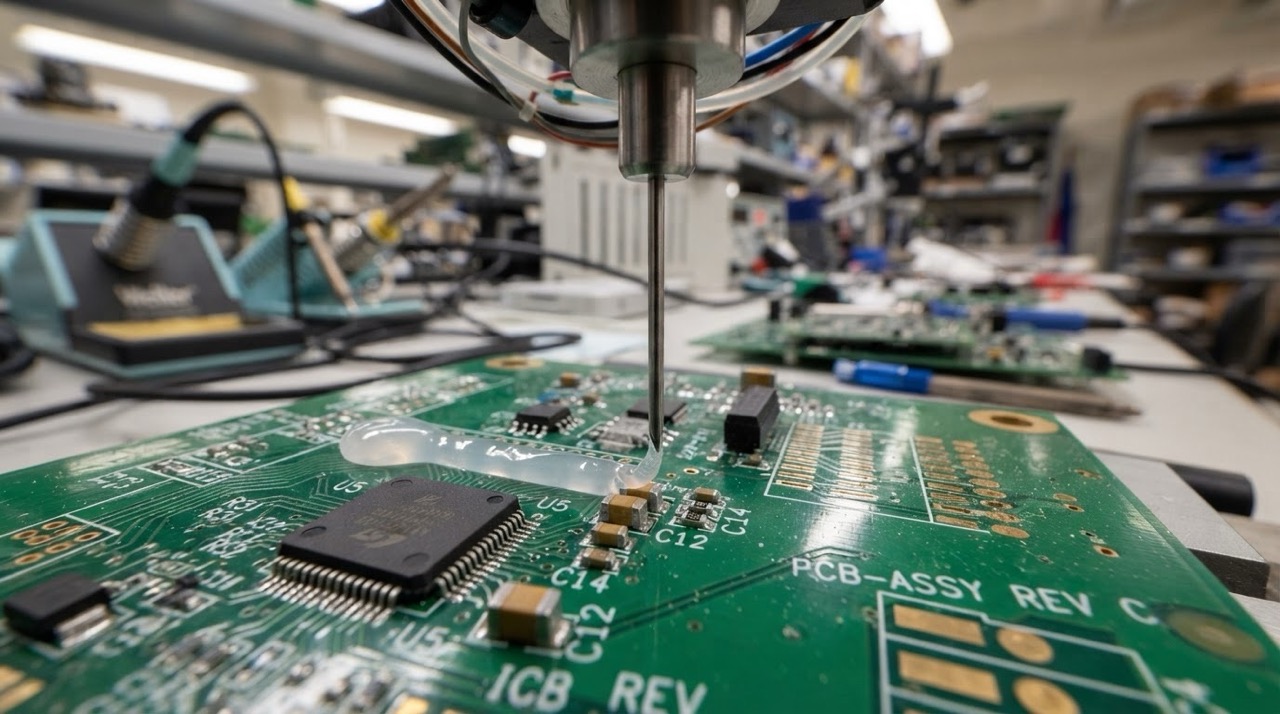
What is RTV silicone and what does it mean?
RTV silicone is a silicone-based material that cures at room temperature. The abbreviation RTV stands for Room Temperature Vulcanising and refers to the material’s ability to polymerise without the use of high temperatures.
RTV silicone refers to a silicone-based material which, once applied, begins a cross-linking process without the need for ovens or high heat.
Once cured, the material becomes elastic, stable and durable.
Depending on the formulation, RTV silicone can take the form of a liquid, paste, thixotropic, gel or non-sagging material. This variety allows it to be used both for precision applications, such as protecting electronic circuits, and for more industrial tasks, such as sealing, bonding and on-site gasketing.
What is meant by room-temperature vulcanisation?
Room-temperature vulcanisation is the process by which RTV silicone cross-links without the need for high temperatures, thanks to moisture in the air or a catalyst.
RTV technology enables the silicone to transition from a workable state to an elastic and stable state. This process is particularly useful when the material needs to be applied to sensitive components, delicate surfaces or complex geometries.
In single-component systems, often referred to as RTV-1, polymerisation occurs due to the moisture present in the air. The product is ready for use and cross-links progressively after application.
In two-component systems, known as RTV-2, the reaction begins when the base and catalyst are mixed. This technology allows for greater control over the process and is used primarily for silicone rubbers, potting and industrial applications where precision and repeatability are required.
An important parameter in RTV-2 systems is the pot-life, i.e. the time within which the mixture can be worked after mixing. The quality of the mould, ease of application and final result all depend on this.
RTV silicone and general-purpose silicone: what is the difference?
RTV silicone is a type of silicone, but not all silicones are RTV: the difference mainly concerns the curing system and the technical application of the material.
When we talk about RTV silicone and silicone in a generic sense, we are not comparing two separate materials. RTV silicone belongs to the family of silicones. However, the abbreviation RTV specifies that this material is formulated to cure at room temperature.
The term ‘silicone’, on the other hand, is broader. It refers to a family of synthetic polymers based on silicon, oxygen and other elements such as carbon and hydrogen. Within this family, there may be materials that differ in consistency, curing process and intended application.
For this reason, the correct question is not “RTV or silicone”, but which type of silicone is required for the specific application. An RTV silicone adhesive, an RTV adhesive and an RTV silicone rubber are all silicone-based materials, but they serve different purposes: sealing, bonding, protecting, insulating or reproducing details.
This distinction is important because, in everyday language, ‘silicone’ is used as a generic term. In a technical context, however, it is essential to understand whether the product is RTV, whether it is single-component or two-component, how it cures and what performance it guarantees.
How to distinguish between types of RTV silicone
RTV silicones are distinguished by the number of components, the cross-linking system, consistency and the final application.
Talking about RTV silicone in general terms is useful for introducing the topic, but it is not enough to choose the correct product. The main types to consider are:
- RTV silicone adhesives and RTV sealants;
- RTV silicone thermally conductive adhesives.
RTV silicone adhesives and RTV sealants
RTV silicone adhesives and RTV sealants are used when adhesion, elastic sealing and protection are required on various substrates.
RTV sealants are primarily designed to seal joints, openings, covers, housings or areas exposed to moisture and contaminants. RTV silicone adhesives, on the other hand, are more focused on adhesion and bonding.
In industrial practice, these functions often overlap. This is why we refer to RTV silicone adhesive sealants: products that bond and seal in a single process, maintaining an elastic and stable joint after curing.
| Product | Type | Applications | Key characteristics |
| DOWSIL™ 7092 High Green Strength Adhesive and Sealant | One-part silicone adhesive sealant | Bonding and sealing of glass, metals and plastics where rapid handling of assembled parts is required. |
|
| DOWSIL™ 7091 Adhesive Sealant | One-part silicone adhesive sealant | Bonding and sealing of metals, glass and plastics in applications requiring high adhesion and flexibility. |
|
| DOWSIL™ 7093 Adhesive Sealant | One-part silicone adhesive sealant | Sealing and bonding applications requiring high movement capability and good adhesion to different substrates. |
|
| DOWSIL™ 7094 Flowable Sealant | One-part, self-levelling silicone adhesive sealant | Sealing of components and assemblies on metals, glass and plastics where a flowable, self-levelling material is required. |
|
RTV silicone thermally conductive adhesives
These thermally conductive RTV silicone adhesives combine adhesion, protection and thermal management.
This type is used primarily in electronics, power electronics, power modules, sensors, inverters and converters. In these applications, RTV silicone must not only bond or seal, but also aid in the transfer of heat to heat sinks or heat exchange surfaces.
The selection process requires precise technical data:
- thermal conductivity;
- dielectric properties;
- viscosity;
- hardness;
- curing time;
- adhesion to substrates;
- temperature range.
| Product | Type | Applications | Key characteristics |
| DOWSIL™ SE 9184 RTV Adhesive | Thermally conductive adhesive | Applications requiring higher thermal conductivity and greater flame resistance. |
|
| DOWSIL™ EA-9189 White RTV Adhesive | Thermally conductive adhesive | Printed circuit boards (PCBs), heat sinks. |
|
Advantages of RTV silicone
RTVsiliconeis chosen because it combines workability at room temperature, elasticity, strength and adaptability to many industrial applications.
The first advantage is that it cures without the need for high temperatures. This allows the material to be applied to sensitive components, electronic circuits and delicate substrates without subjecting them to aggressive thermal stress.
A second advantage is its flexibility. After cross-linking, RTV silicone retains elastic properties, making it suitable for sealing, absorbing vibrations, compensating for expansion and protecting components subject to movement.
RTV silicones are also valued for their heat resistance, moisture resistance, weather resistance, UV resistance and resistance to various chemicals. In the electronics sector, a key advantage is electrical insulation, which helps to protect circuits, modules and components from dust, contaminants and short circuits.
Applications of RTV silicone
RTV silicone is used across many sectors because it can seal, bond, insulate, protect or reproduce details with precision.
The applications of RTV silicones are extensive because the technology can be adapted to different requirements. Some products are developed for electronics, others for gaskets, industrial sealing or protection in challenging environments.
RTV silicone for electronics
In the electronics sector, RTV silicone protects circuits, modules and components from moisture, dust, vibrations, contaminants and thermal shocks.
Electronics is one of the most important areas for industrial RTV silicones. Here, the material is used to protect sensitive components and improve the reliability of devices and systems.
Applications include printed circuit boards, electronic modules, housings, covers, power components, sensors, inverters, converters and control units. RTV silicone can perform the following functions:
- sealing;
- bonding;
- electronic protection;
- electrical insulation;
- mechanical stabilisation;
- encapsulation.
In this field, brands such as DOWSIL™ are leading names for sealants, protective materials, potting compounds and solutions for industrial electronics.
| Product | Type | Applications | Key characteristics |
| DOWSIL™ SE 9188 RTV Adhesive | Adhesive for electronics | Printed circuit boards (PCBs), covers and housings. |
|
| DOWSIL™ 744 RTV Adhesive Sealant | Adhesive for electronics | Batteries, printed circuit boards (PCBs), covers and housings. |
|
| DOWSIL™ 3145 RTV Mil-A-46146 Adhesive / Sealant | Adhesive for electronics | Electrical cables, printed circuit boards (PCBs), covers and housings, thermal interfaces. |
|
| DOWSIL™ 3165 Fast Tack RTV Adhesive Sealant | Adhesive for electronics | Electrical cables, printed circuit boards (PCBs), covers and housings, thermal interfaces. |
|
RTV silicone conformal coatings for PCBs
The RTV silicone conformal coatings protect printed circuit boards and electronic boards by creating a thin, insulating and durable coating.
In the electronics sector, a significant proportion of RTV solutions relates to conformal coatings. These coatings are applied to PCBs and electronic circuits to help protect them from moisture, contaminants, abrasion and stress.
Compared to a sealant adhesive, a conformal coating serves a more specific purpose: its primary function is not to bond or fill, but to create a protective coating that conforms to the board’s geometry.
| Product | Type | Applications | Key characteristics |
| DOWSIL™ 1-2620 Dispersion RTV Elastoplastic Conformal Coating | Conformal coating | Printed circuit boards (PCBs), electronic circuit protection. |
|
| DOWSIL™ SE 9189 L RTV | Conformal coating | Electronic protection. |
|
| DOWSIL™ 3-1944 RTV Coating | Conformal coating | Printed circuit boards (PCBs), electronic circuit protection. |
|
| DOWSIL™ 3140 RTV Coating | Adhesive for electronics / RTV coating | Printed circuit boards (PCBs), electronic circuit protection. |
|
RTV silicone for aerospace and defence
In the aerospace sector, RTV silicone is chosen when stability, reliability and protection of critical components are required.
In the aerospace and defence sectors, RTV silicone adhesives and sealants can be used to protect electronic modules, seal wiring harnesses, stabilise components and support applications subject to vibration, thermal shock and high technical requirements.
In these contexts, product selection is governed by stringent specifications. Requirements may include thermal stability, mechanical strength, low emission of volatile compounds, reliable adhesion and compliance with industry standards.
Among the products suitable for technical applications is DOWSIL™ 3145 RTV Mil-A-46146 Adhesive / Sealant, a one-component silicone adhesive and sealant that cures at room temperature, offers high thermal stability and is certified to MIL-A-46146 Group II/III, TY I.
How to choose the correct RTV silicone
Choosing the right RTV silicone depends on the application, substrate, process, curing times and required performance.
When selecting an RTV silicone, one should start with the application, not the generic category. The same designation can refer to very different products.
For electronic applications, one must assess electrical insulation, protection against moisture and contaminants, resistance to thermal shock, compatibility with PCBs and components, elastic modulus and long-term stability.
For industrial adhesives and sealants, adhesion to substrates, chemical resistance, elasticity, temperature behaviour, curing times and application methods are key factors.
For RTV silicone thermally conductive adhesives, even more specific data is required: thermal conductivity, dielectric properties, thermal stability and compatibility with heat sinks, modules and electronic components.
Why RTV silicone remains a cross-cutting technical solution
The value of RTV silicone lies in its ability to adapt to different requirements whilst maintaining a clear technical principle: to cure at room temperature and transform into a flexible, stable and functional material.
For this reason, talking about RTV silicone does not mean talking about a single product, but rather a technology applicable to various contexts and different industries. Making the right choice always requires an assessment of the substrate, application method, process times, operating conditions and final performance.
For more information on RTV silicones and to assess whether these products could be the right solution for your application, contact our experts at MD Poland.

