
Key points about thermal paste
- Thermal paste improves the transfer of heat between an electronic component and a heat sink.
- Thermally conductive and electrically conductive pastes serve different functions and should not be confused.
- Thermal pastes can have a silicone-based or non-silicone-based matrix.
- Temperature, geometry, application process, and electrical requirements all influence the choice of product.
- IGBTs, inverters, charging stations, batteries, and microprocessors are some of the most common industrial applications.
When an electronic component is operating, it generates heat. The problem arises when that heat cannot be dissipated quickly enough.
This is a common issue in power electronic circuits, inverters, control units, microprocessors, and many other devices in which temperature can directly affect the proper functioning and lifespan of components.
The challenge is not merely the presence of a heat sink. In fact, small gaps filled with air may remain between the component generating heat and the heat sink. And air is not a good conductor of heat.
It is precisely at this interface that thermal paste, also known as thermally conductive paste, thermally conductive grease, or heat-dissipating paste, comes into play. Its function is to create a more effective thermal contact between the surfaces and to facilitate the transfer of heat to the heat sink.
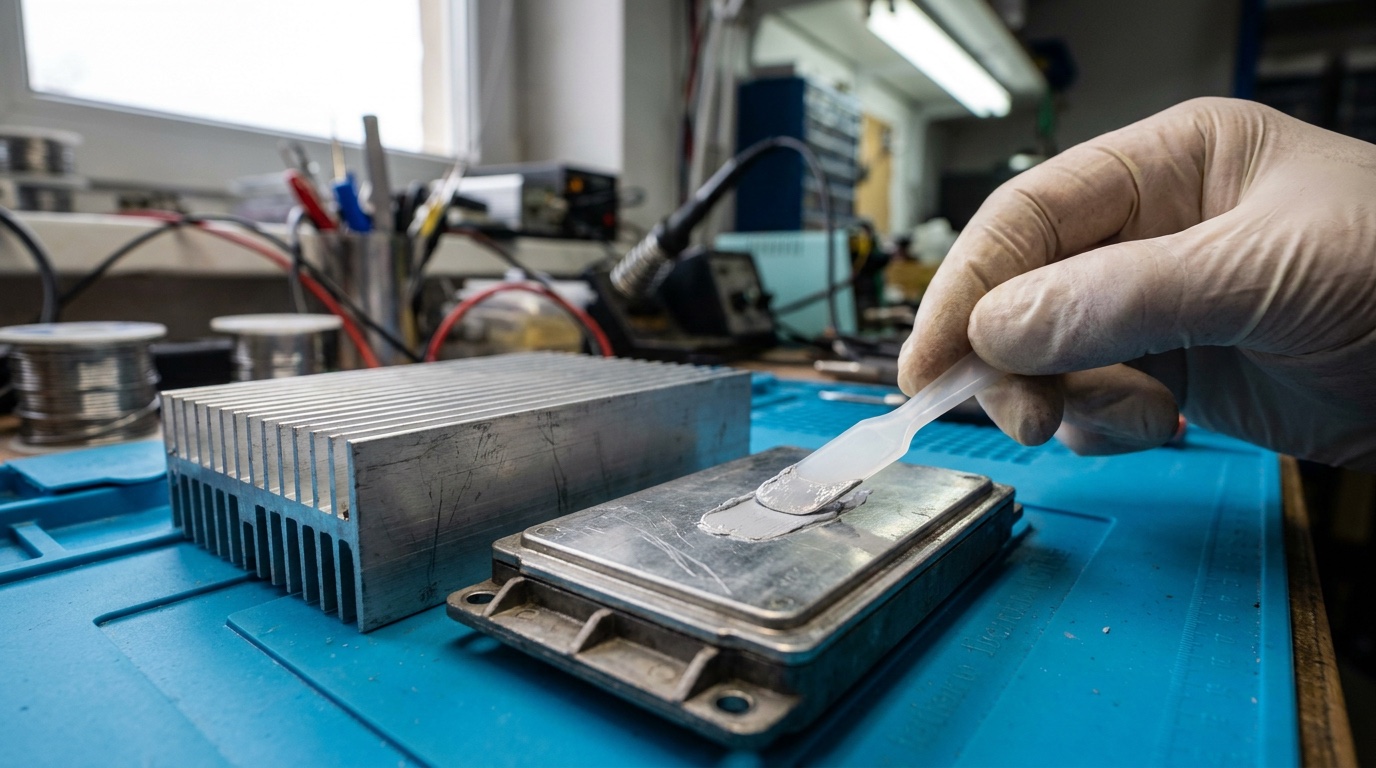
Table of Contents
- Conductive pastes: the difference between thermally conductive and electrically conductive
- What is thermal paste and what is it used for
- Types of thermal paste: silicone-based and non-silicone-based
- How to choose a thermal paste for electronics
- Applications of thermally conductive pastes in electronics
- How thermal paste is applied
- Frequently asked questions about thermal paste
- Find the right thermal paste for your application
Conductive pastes: the difference between thermally conductive and electrically conductive
The term conductive paste generally refers to a material in a paste-like form formulated to facilitate a conduction process.
In electronics, however, this term can refer to very different properties: a formulation may be designed to transfer heat or to allow the passage of electric current. For this reason, simply referring to “conductive paste” without specifying its function can create ambiguity.
When referring generically to conductive paste, one may therefore be referring to two families of very different materials, and it is precisely in this distinction that the fundamental difference between thermally conductive and electrically conductive pastes lies:
A thermally conductive paste facilitates heat transfer between the component and the surface responsible for dissipating it. In this case, the paste is electrically insulating.
An electrically conductive paste is designed to create electrical conductivity between the relevant parts. It therefore improves electrical conductivity between two surfaces and, since it is typically formulated with noble metals, it is simultaneously thermally conductive.
In applications dedicated to thermal dissipation, the goal is typically to transfer heat without simultaneously creating an electrically conductive path between components.
This does not mean, however, that any thermal paste can automatically be considered electrically insulating. The electrical properties depend on the specific formulation and must be verified for the selected product.
What is thermal paste and what is it used for
Thermal paste is a material used between a component that generates heat and a surface responsible for dissipating the heat.
The principle can be explained simply:
electronic component → thermal paste → heat sink
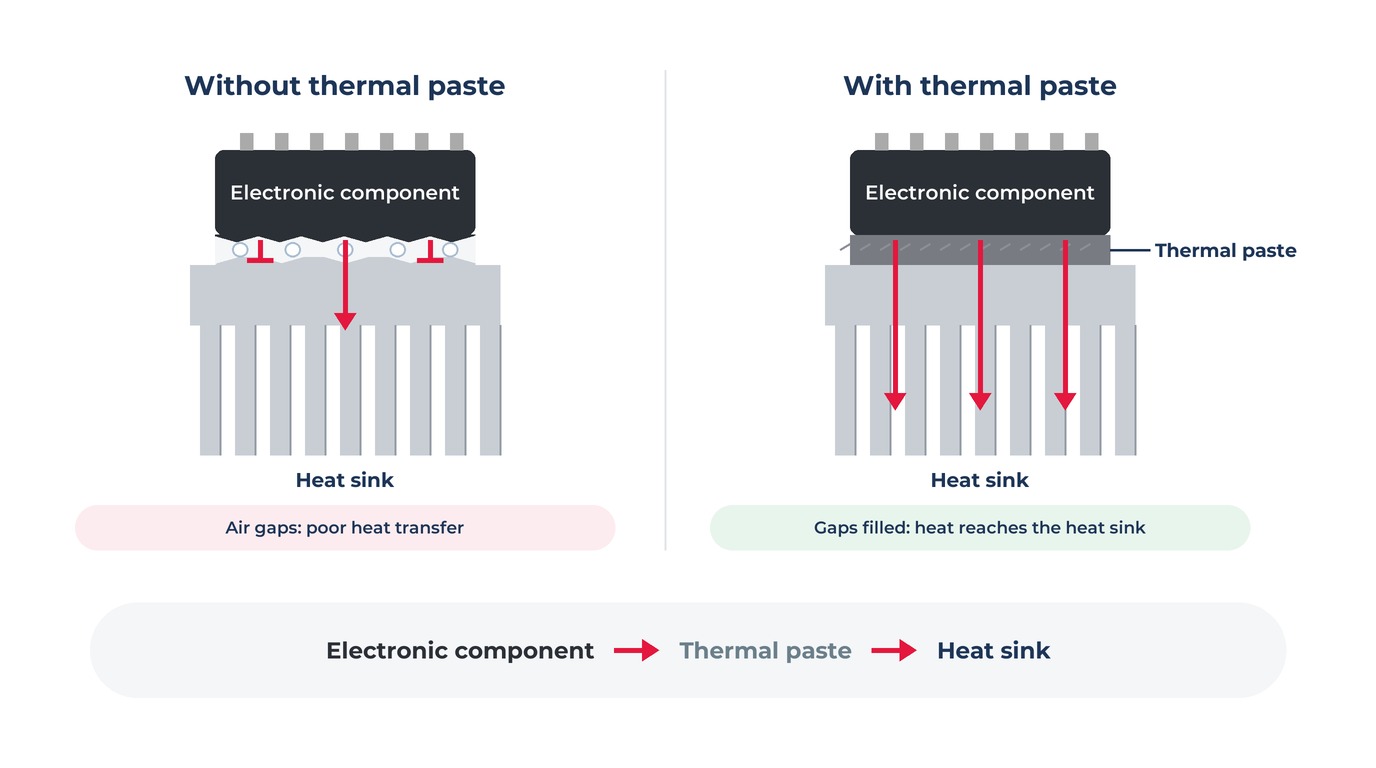
The two surfaces to be mated are not, in fact, perfectly uniform. Even when they appear to adhere properly, small voids and irregularities may remain. Without an interface material, these spaces are filled with air, which is a very poor heat conductor.
The thermal paste, on the other hand, spreads out between the surfaces, fills the irregularities, and allows the heat to reach the heat sink more easily.
This principle is particularly evident in power electronics. Between a circuit board and an aluminum heat sink, there may be small areas filled with air. By applying thermal paste, the heat generated by the component can be transferred to the heat sink more effectively, helping to prevent overheating.
Why thermal pastes are used
Thermally conductive pastes are particularly useful when the interface to be filled is thin.
Among the main application advantages are the ability to create layers that are very thin, to adapt to surfaces that are not perfectly uniform, and, in the case of non-curing formulations, to be used without a mixing or curing step.
However, this simplicity does not mean that a thermally conductive paste is indiscriminately suitable for any application. Depending on the formulation and operating conditions, it is also necessary to evaluate aspects such as:
- migration of the material;
- pump-out during operation;
- separation or sedimentation;
- behavior over time at high temperatures.
The selection must therefore be based on the electronic system as a whole, not just on a single thermal conductivity value.
Types of thermal paste: silicone-based and non-silicone-based
One of the main distinctions among thermal pastes concerns the material matrix.
The two main categories are:
- silicone-based thermal pastes;
- non-silicone-based thermal pastes.
These are not simply two variants of the same product. The matrix can influence the behavior of the paste, the operating temperature, and compatibility with the application.
DOWSIL™ Silicone Thermal Pastes
Silicone thermal pastes use a silicone-based matrix and are particularly useful when the application must operate at high temperatures.
In general, silicone thermal pastes tend to maintain their performance over a wider temperature range than non-silicone formulations. As a rough guide, many silicone pastes can withstand temperatures in the range of 200 °C, while numerous non-silicone formulations are typically limited to around 120-130 °C.
However, the operating temperature remains a specific characteristic of each individual formulation and must always be verified in the relevant technical data sheet.
Among the silicone solutions in the MD Poland product line are several DOWSIL™ pastes.
| Product | Key characteristics |
| DOWSIL™ TC-5026 | Non-curing, thermally conductive silicone compound, suitable for forming thin thermal interfaces and dissipating heat from electronic components. Offers a very good balance of low bond line thickness, thermal conductivity and thermal resistance. |
| DOWSIL™ TC-5121C LV | Non-curing silicone thermal paste, designed to provide low thermal resistance and good stability at the interface. |
| DOWSIL™ TC-5080 | Thermally conductive silicone paste, designed to provide good heat transfer and maintain stability, even at high temperatures. |
| DOWSIL™ TC-5622 | Solvent-free, thermally conductive silicone compound, easy to apply and suitable for dissipating heat in electronic components. |
| DOWSIL™ 340 Heat Sink Compound | Non-curing, thermally conductive silicone compound, used to promote heat transfer from electronic components to the heat sink. A general-purpose product, it is one of the most widely used on the market. |
| DOWSIL™ TC-5351 | Non-curing, thermally conductive paste, suitable for thermal management, including on geometries and surfaces that require good material stability. Its paste consistency also enables it to fill larger gaps. |
| DOWSIL™ 5888 | Non-curing, thixotropic thermal paste, suitable for applications requiring high performance. |
Electrolube and E-MAX silicone thermal paste
In addition to DOWSIL™ solutions, MD Poland also offers Electrolube silicone thermal pastes and EMAX, suitable for various thermal management needs in electronics.
| Product | Key characteristics |
| Electrolube HTS | General-purpose, thermally conductive silicone paste, suitable for promoting heat transfer, including in high-temperature applications. |
| Electrolube HTSP | Silicone thermal paste, developed for applications requiring enhanced thermal performance. Also suitable for screen printing. |
| E-MAX TGS606C | Thermally conductive silicone paste for the thermal management of electronic components in applications requiring high performance. |
DOWSIL™ TC-5026 in an inverter’s IGBTs
A particularly representative example involves the thermal management of IGBTs, power components used in inverters.
During operation, these components generate heat. If the temperature becomes too high, they may operate outside their specified conditions and become damaged.
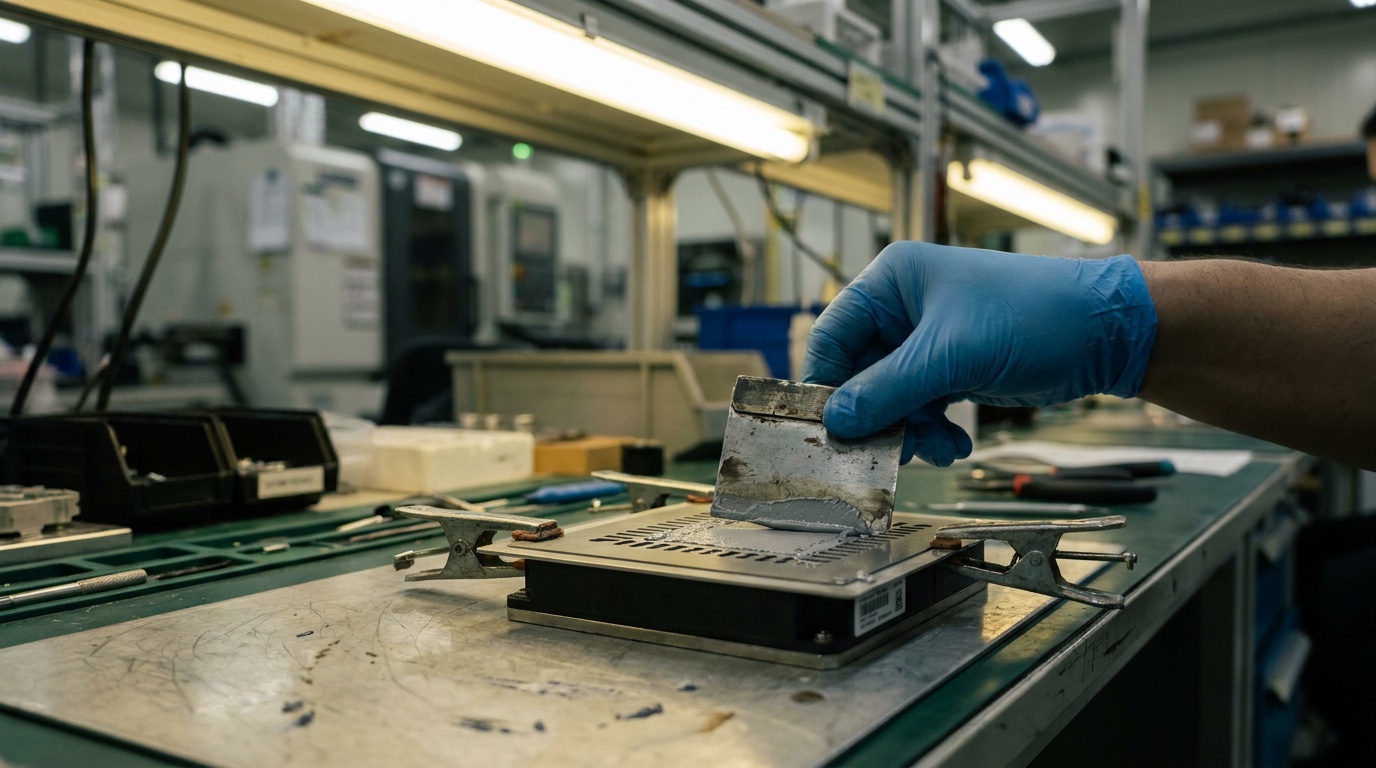
In this application, DOWSIL™ TC-5026 is applied to the back of the IGBTs. The thermal interface material is dispensed through a stencil, which ensures a precise pattern and controlled thickness. The module is then mated to the circuit board and the associated heat dissipation system.
The point is not simply to add material between the two surfaces. The goal is to create an interface through which the heat generated by the IGBTs can more effectively reach the aluminum heat sink.
This solution is used, for example, in the inverters found in electric vehicle charging stations, where the power electronics must handle high amounts of energy and, consequently, generate significant heat.
Thermal paste in the management of a control unit on an industrial vehicle
Another application concerns industrial electric vehicles.
In this case, the system includes a battery pack and a plate responsible for carrying away the heat generated during operation.
A silicone-based thermally conductive compound is used between the electronic system and the surface designated for heat dissipation. The principle is the same as that seen in the case of IGBTs: improving thermal contact between the surfaces so that heat can be transferred to the component responsible for dissipating it.
This application clearly demonstrates how thermal pastes are not limited to the world of computers, but are also used in E-Mobility, battery-powered systems, and industrial electronics.
Non-silicone thermal pastes
Not all applications require a silicone matrix.
Non-silicone formulations represent a second family of thermal pastes and can be used when the design requires avoiding the presence of silicone or when operating conditions make a different matrix more suitable.
MD Poland’s solutions include products from the Electrolube line.
| Product | Key characteristics |
| Electrolube HTC | Non-silicone, thermally conductive paste based on synthetic fluids and thermally conductive materials. |
| Electrolube HTCP | Non-silicone, thermally conductive paste, designed to facilitate heat transfer and avoid issues associated with the presence and migration of silicone. It is an enhanced version of HTC, offering greater heat dissipation. |
This distinction should not be interpreted as a comparison between a “better” and a “worse” solution. The correct question is:
Which matrix best meets the conditions of the specific application?
How to choose a thermal paste for electronics
Focusing solely on thermal conductivity risks oversimplifying the issue. A thermal paste for electronics operates within a system and must be selected based on how it will actually be used.
Operating temperature
Temperature is one of the primary factors. If the application generates high temperatures, the product’s matrix and its operating range become particularly important.
The distinction between silicone thermal pastes and non-silicone thermal pastes also stems from this: within the ranges under consideration, the former generally allow operation at higher temperatures than many non-silicone formulations.
Component type and application
Dissipating heat generated by the following is not the same:
- an IGBT;
- a CPU;
- a power module;
- a control unit;
- an electronic board;
- a system connected to a battery pack.
The geometries, surfaces, operating conditions, and amount of heat to be transferred all vary. For this reason, the question should not simply be: “What is the best thermal paste?” but rather: “What is the most suitable thermal paste for this application?”
This is an important distinction, especially in the industrial sector, where the choice must be based on the specific design rather than on a generic product ranking.
Interface thickness
Thermal pastes are particularly effective when they need to create thin layers between a component and a heat sink. In some applications, the thickness is controlled using stencils or other deposition systems.
The amount of material should not be chosen at random. The goal is to create the interface necessary to establish thermal contact between the two surfaces. However, when the gap to be filled becomes wider or has significantly different geometries, it may be necessary to evaluate other thermal interface technologies.
Electrical requirements
Thermally conductive does not automatically mean electrically conductive. In many electronic applications, it is necessary to transfer heat while simultaneously maintaining adequate electrical insulation.
The electrical properties must therefore be verified for each individual product and considered alongside the thermal characteristics. It is incorrect to assume that any thermal paste automatically guarantees the same level of insulation.
Application process
The manufacturing process also influences the choice.
Depending on the formulation, a paste can be applied via:
- dispensing;
- stencil;
- screen printing;
- serigraphy;
- manual application.
The most suitable solution therefore also depends on how the material is to be integrated into the manufacturing process and on the level of control required over geometry and deposited thickness.
Long-term stability and reworkability
In the case of non-curing pastes, the behavior of the material during use must also be considered.
Depending on the formulation and operating conditions, phenomena such as the following may become significant:
- migration;
- pump-out;
- separation;
- sedimentation;
- aging at high temperatures.
At the same time, the fact that the material remains uncured can facilitate rework or replacement of the component. This aspect must also be evaluated based on the project’s requirements.
Applications of thermal conductive pastes in electronics
Thermal pastes are used in numerous industries, from electronics to e-mobility, to applications for the production and conversion of energy.
The common denominator is always the same: a component generates heat, and this heat must be transferred to a surface capable of dissipating it.
Thermal paste for IGBTs and inverters
IGBTs are one of the clearest examples. These are power components commonly used in inverters that generate significant amounts of heat during operation.
Thermal paste is applied at the interface with the heat sink so that the heat produced can be transferred more effectively.
Thermal paste in charging stations
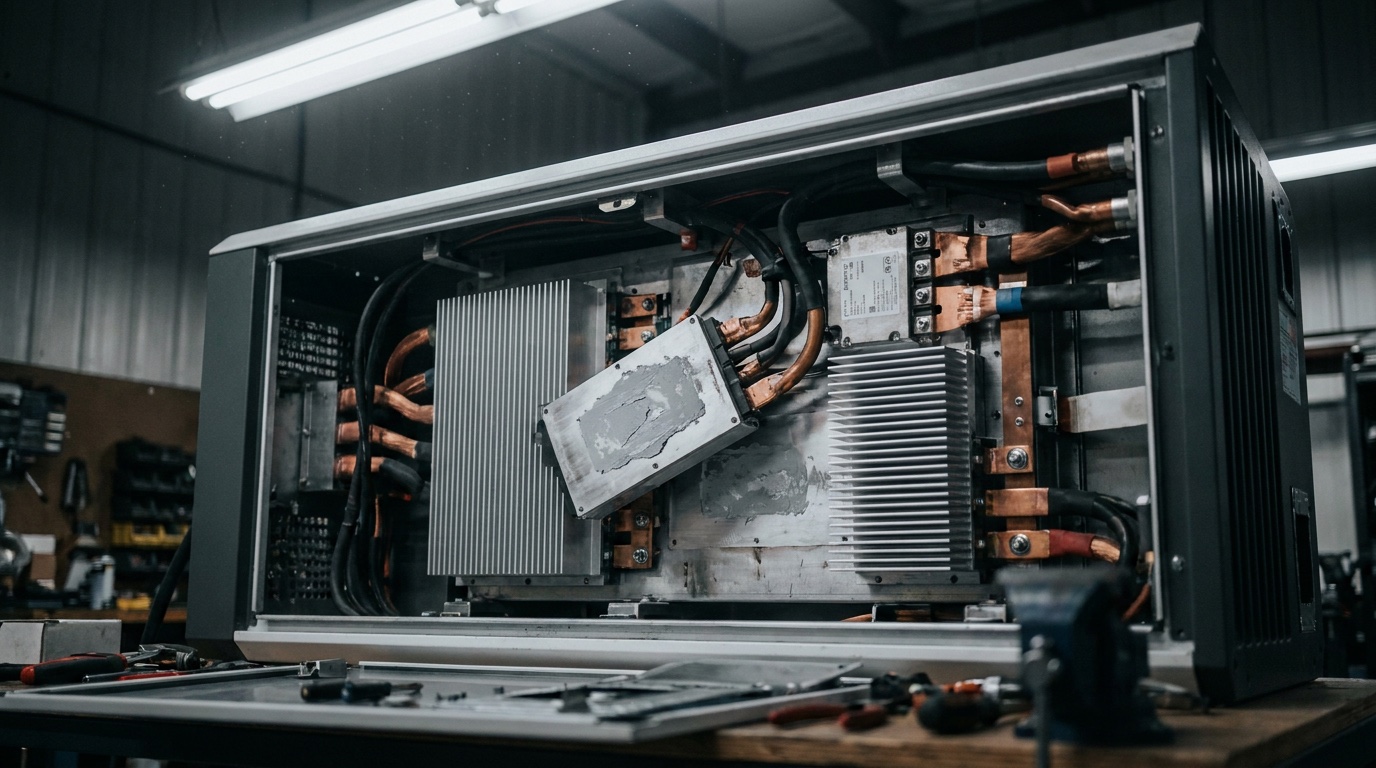
Electric vehicle charging stations are one of the possible applications for inverters. During the transfer of energy to the vehicle, the power electronics must handle high loads and can generate significant amounts of heat.
By applying a thermally conductive paste to the interface between the electronic module and the aluminum heat sink, heat can be transferred more effectively to the surface responsible for dissipating it.
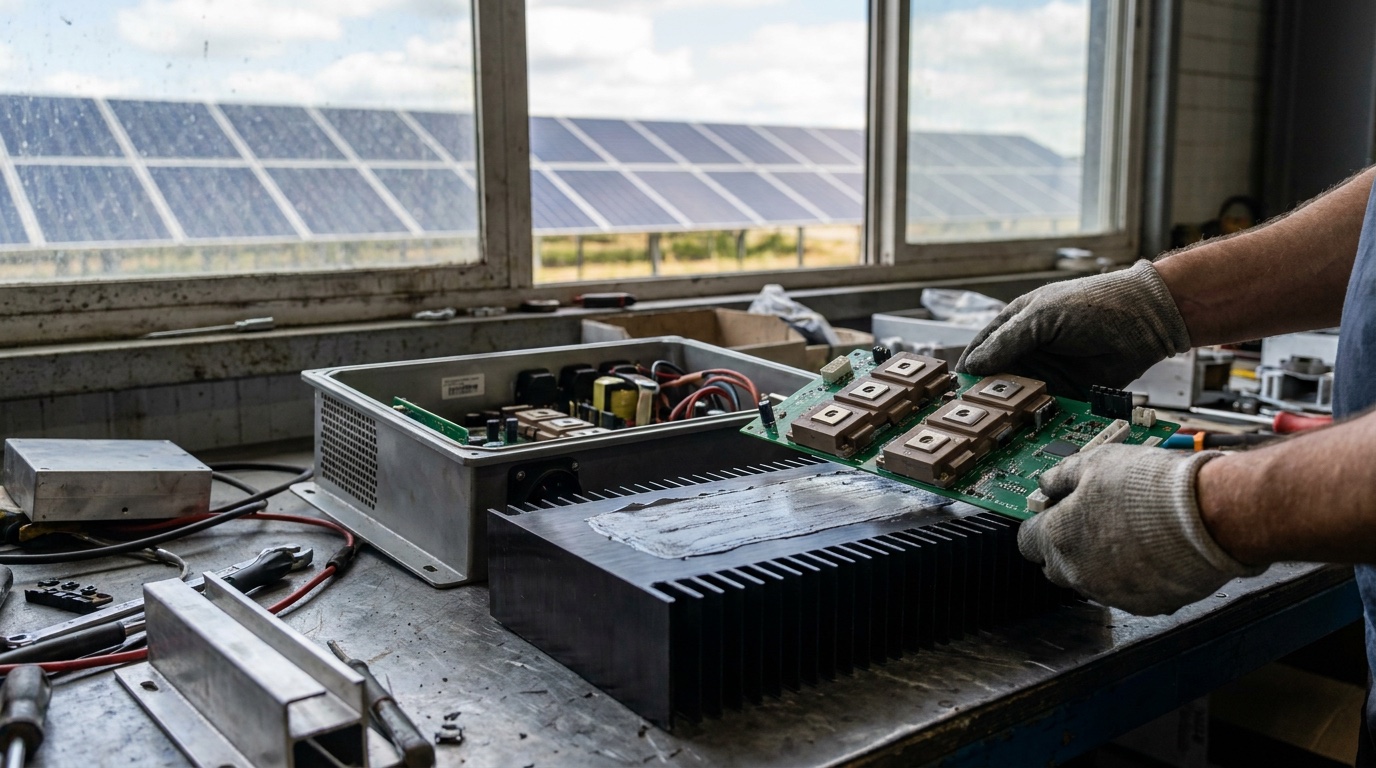
Thermal paste for photovoltaic and wind power inverters
The same principle applies to inverters used in systems for the production of energy.
Possible applications include:
- photovoltaic systems;
- wind power plants;
- systems in which energy must be converted between direct and alternating current.
In these cases as well, power electronics generate heat and require proper thermal management.
Thermal paste for batteries and industrial vehicles
Another area of application involves electric industrial vehicles and battery-powered systems.
The heat generated by the system must be transferred to plates or other surfaces designed to dissipate it. Thermal paste can be used to improve thermal contact between the components and the heat dissipation system.

Thermal paste for CPUs and industrial microprocessors
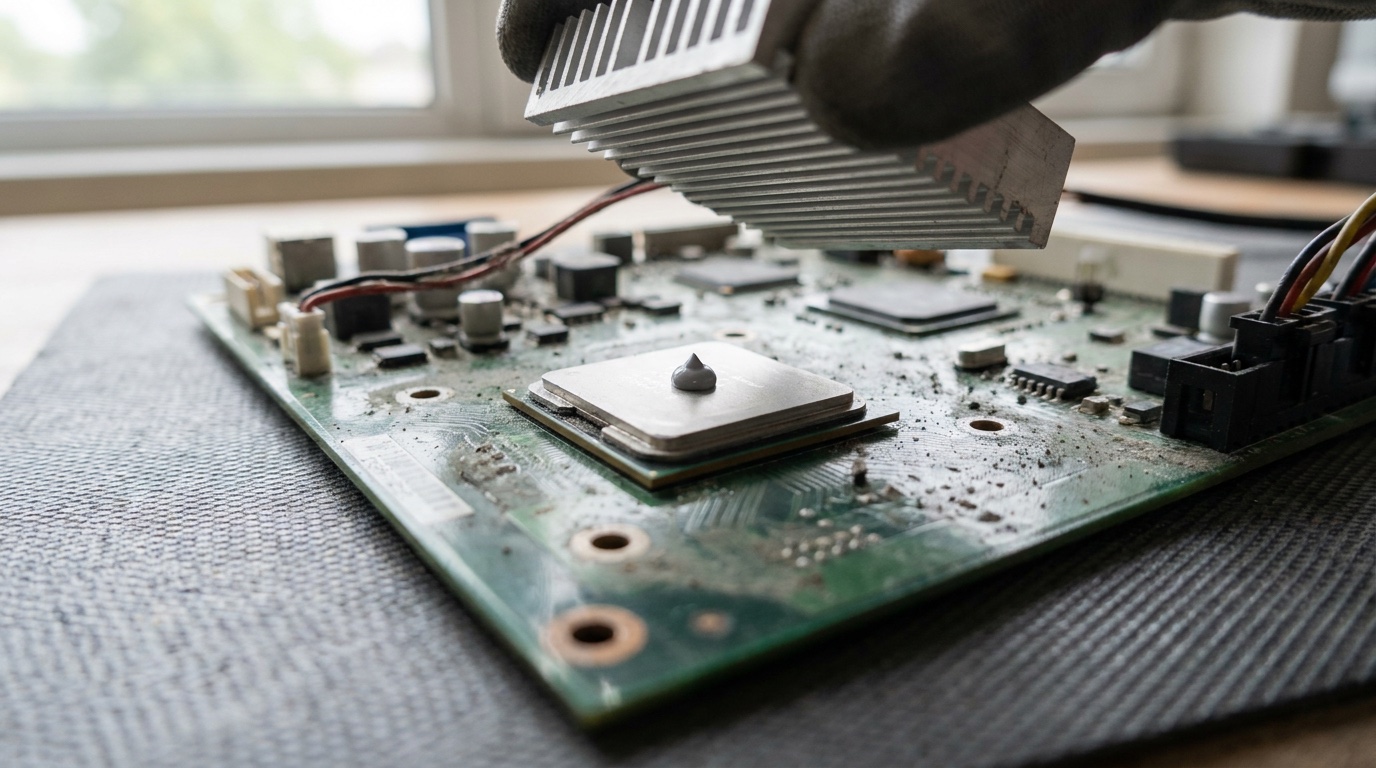
CPUs and microprocessors generate heat during operation and must therefore be coupled with a system capable of effectively dissipating it.
Thermal paste is applied between the component and the heat sink; it spreads across the interface between the two surfaces and facilitates heat transfer to the heat sink.
The same principle also applies to microprocessors used in industrial electronics, such as those found in machines, control systems, and other professional equipment.
In all these cases, the paste’s function remains the same: to improve thermal contact between the heat-generating component and the surface responsible for dissipating the heat.
How thermal paste is applied
There is no single application method that works for every component. In the case of the IGBTs discussed earlier, for example, a stencil is used.
The material is dispensed onto the surface and transferred through the stencil to achieve:
- a defined geometry;
- a controlled thickness;
- a repeatable distribution.
In other cases, dispensing, screen printing, or serigraphy may be used, depending on the formulation and the manufacturing process.
The goal is not to apply as much material as possible. A thermal paste must create the interface necessary to establish thermal contact between the surfaces according to the requirements defined by the design.
Frequently asked questions about thermal paste
What is thermal paste used for?
Thermal paste is applied between a heat-generating component and the heat sink. It fills in irregularities and small gaps between surfaces, facilitating heat transfer to the heat sink.
Are thermal paste and thermally conductive paste the same thing?
In the context of thermal management for electronic components, these terms are commonly used to refer to the same family of materials. Terms such as thermal grease, thermally conductive grease, and heat-dissipating paste are also widely used.
What is the difference between thermally conductive paste and electrically conductive paste?
Thermally conductive paste is designed to facilitate heat transfer. Electrically conductive paste, on the other hand, is used to provide electrical conductivity. These two functions should not be confused.
What is the difference between silicone-based and non-silicone-based thermal paste?
The difference primarily concerns the product’s matrix. Silicone-based pastes are particularly suitable when the application requires operation at high temperatures, while non-silicone-based formulations may be preferred when it is necessary to avoid the presence or migration of silicone.
Where is thermal paste used?
It can be used on PCBs, microprocessors, power modules, IGBTs, inverters, control units, and other electronic systems in which heat must be transferred from the component to a heat sink.
How do you choose a thermal paste for high temperatures?
Temperature is one of the key parameters, but not the only one. It is also necessary to evaluate the component, the interface geometry, the required electrical properties, the application process, and the material’s stability under the expected operating conditions.
Find the right thermal paste for your application
The choice of thermal paste depends on the component’s characteristics, the operating temperature, the interface to be managed, and the application process.
MD Poland offers various DOWSIL™, Electrolube, and E-MAX solutions for thermal management in electronics and supports designers and companies in identifying the most suitable product.
For more information on thermally conductive pastes, contact our MD Poland experts or visit the dedicated page on our website.

